# OSHA heat index chart for breaks
> The four OSHA heat index bands (below 91°F, 91°F, 103°F, 115°F), the breaks each one calls for, and a one-page chart you can print for the break trailer.
- Source: https://www.clemacooling.com/osha-heat-index-break-chart
- Author: Anna B. Albright
- Published: 2026-08-10
- Last updated: 2026-08-10
- Publisher: Clema, Inc. (https://www.clemacooling.com)
**Four risk bands, and two escalation rules that move you up a band before the thermometer does.**
Heavy PPE alone can put a crew in the higher tier at 91°F.
[Full OSHA heat standard](https://www.clemacooling.com/osha-heat-standard)
Lower risk: Extreme
<91°F; 91°F; 103°F; 115°F+
## The four risk bands.
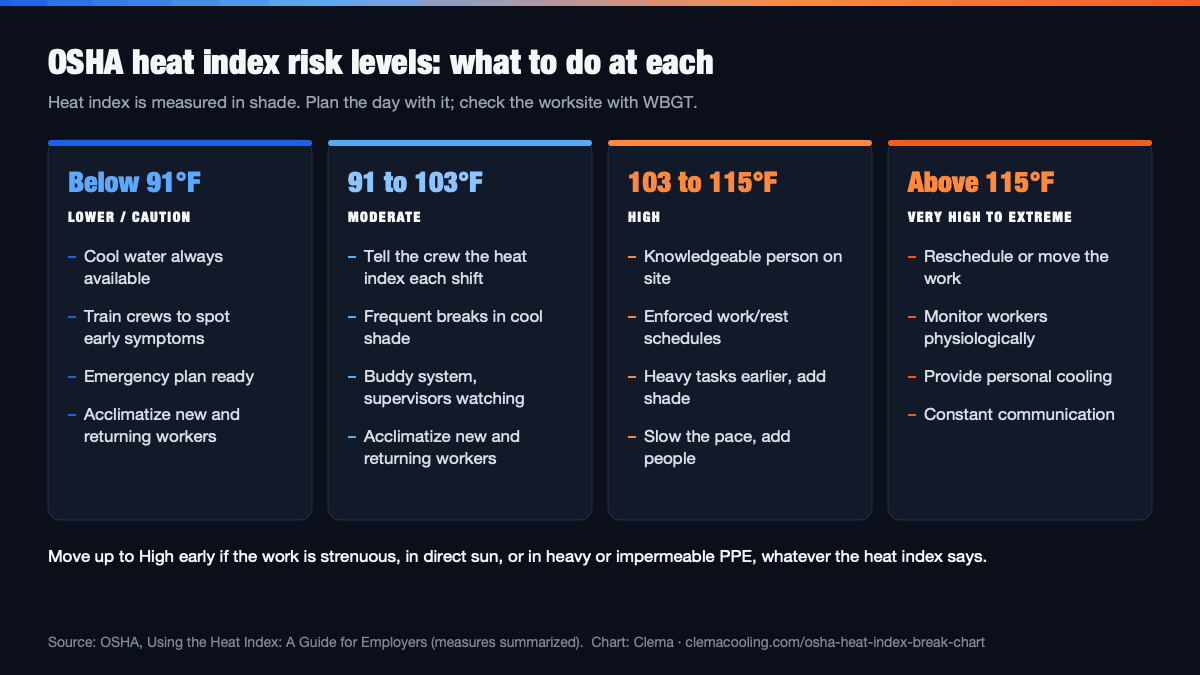
Below 91°F
Lower / Caution
- **Cool drinking water**, always available.
- Train workers and supervisors to spot early symptoms.
- Have an **emergency plan** for suspected heat illness.
- Acclimatize new and returning workers.
91 to 103°F
Moderate
- **Tell the crew the heat index** at the start of the shift.
- Schedule **frequent breaks in cool, shaded areas**.
- Acclimatize new and returning workers.
- If the heat index jumps suddenly, give **everyone** extra breaks for a few days.
- Buddy system. Supervisors actively watching, not just present.
103 to 115°F
High
- Put a **knowledgeable person on site** who can change the plan.
- **Set and enforce work/rest schedules.** Not suggested. Enforced.
- Change the work: heavy tasks earlier, add shade, relocate jobs.
- Only **acclimatized** workers on the most strenuous tasks.
- Slow the pace. Add people so nobody works faster in the heat.
Above 115°F
Very high to extreme
- **Reschedule the work**, or move it somewhere cooler.
- Monitor workers physiologically, not by eye.
- **Provide personal cooling measures.** OSHA names this explicitly.
- Extra work/rest precautions, buddy system, constant communication.
Source: OSHA, *Using the Heat Index: A Guide for Employers*. Measures summarized; the full guide carries more detail per band.
## Two rules that escalate you early.
The chart above is what people screenshot. These two rules are what actually change decisions on site, and they are why a crew can be owed High Risk protections on a 91°F morning.
OR
### Go to High Risk if…
The heat index approaches 103°F **or** the work is strenuous, in direct sunlight, or involves heavy, non-breathable, or impermeable protective clothing.
AND
### Go to Very High if…
The heat index approaches 115°F **and** the work is being done in direct sunshine.
Read the first one twice. It is an **OR**. Strenuous work, direct sun, or sealed-up PPE each push you into the High Risk tier on their own, whatever the thermometer says. A crew in coveralls in open sun is arguably in that tier through most of an American summer, and almost no heat plan is written that way.
## How to set the cycle.
OSHA gives no single break interval on purpose, because a fixed number is wrong for most sites. The guidance is structural: spread work across the day, build cycles, and spend the rest half somewhere genuinely cool. Short frequent exposures beat long ones.
| Shorten work and lengthen rest as… | Because |
| --- | --- |
| Temperature rises | Less margin before core temperature climbs |
| Humidity rises | Sweat stops evaporating, the main cooling route closes |
| Sun gets stronger | Radiant load adds heat the air temperature does not show |
| Air movement drops | No convection to carry heat away |
| Protective clothing is worn | Traps heat and blocks evaporation |
| The work gets heavier | More metabolic heat produced internally |
- **New and returning workers** get lighter work, longer rest, closer watching. OSHA reports almost half of heat deaths happen on a worker's first day and over 70 percent in the first week. More in [the 2026 enforcement update](https://www.clemacooling.com/blog/osha-heat-national-emphasis-program-2026).
- **The rest area matters as much as the interval.** Genuinely cool, clear of traffic, noise and falling objects, big enough for everyone at once, near cool water.
- **Watch the breeze.** Air that feels uncomfortably hot adds heat load rather than removing it. Shelter people from it.
## OSHA would rather you used WBGT.
- OSHA says plainly the heat index **does not measure worksite heat as accurately as WBGT**, and warns against relying on forecast heat index because it can understate real risk.
- Heat index is measured **in shade**. It knows only air temperature and humidity.
- It knows nothing about sun on a worker's back, radiant heat off concrete or an engine, whether air is moving, or whether someone is sealed inside PPE.
- [Wet bulb globe temperature](https://www.clemacooling.com/glossary) accounts for all of it, which is why NIOSH limits are written in WBGT.
- For WBGT limits by workload and how to measure it on site, see [WBGT work/rest limits](https://www.clemacooling.com/wbgt-work-rest-limits). For how often heat actually puts workers in hospital, see [workplace heat injury statistics](https://www.clemacooling.com/workplace-heat-injury-statistics).
- **Use heat index to plan the day. Use WBGT, measured where the work happens, to decide if the work is safe.**
| Workload | WBGT limit, unacclimatized | WBGT limit, acclimatized |
| --- | --- | --- |
| Light | 82.4°F | 86.0°F |
| Moderate | 77.0°F | 82.4°F |
| Heavy | 73.4°F | 78.8°F |
| Very heavy | 69.8°F | 77.0°F |
Source: OSHA heat hazard recognition guidance. Effective WBGT equals measured WBGT plus a clothing adjustment, so heavy or impermeable clothing raises the effective reading before you measure anything.
- At the top band OSHA names **personal cooling measures** as a protective action. Not a substitute for water, shade and rest. The control that still works when the job cannot stop.
- Compare options in the [cooling vest comparison](https://www.clemacooling.com/cooling-vest-comparison) and [how long each type lasts](https://www.clemacooling.com/how-long-does-a-cooling-vest-last).
- Fit decides whether any of it gets worn. See [fit and sizing](https://www.clemacooling.com/cooling-vest-fit-and-sizing).
- State rules: [California](https://www.clemacooling.com/cal-osha-heat-standard), [Washington](https://www.clemacooling.com/washington-heat-standard), [Oregon](https://www.clemacooling.com/oregon-heat-standard), [Nevada](https://www.clemacooling.com/nevada-heat-standard), [Maryland](https://www.clemacooling.com/maryland-heat-standard).
Source: OSHA, Using the Heat Index: A Guide for Employers, and OSHA heat hazard recognition guidance.
Reference copy from clemacooling.com/osha-heat-index-break-chart. Not a substitute for your own heat illness prevention plan.
## Use this chart in your heat plan.
Put it in a toolbox talk, a safety binder, your intranet or a site trailer. It is free to use as long as the credit line and link stay with it.
[](https://www.clemacooling.com/assets/embed/osha-heat-index-chart.png)
Embed code for a website or intranet page:

Chart: OSHA heat index break chart by Clema
[Download PNG](https://www.clemacooling.com/assets/embed/osha-heat-index-chart.png)
[Download SVG](https://www.clemacooling.com/assets/embed/osha-heat-index-chart.svg)
## Heat index breaks, answered.
### What are OSHA's heat index risk levels?
OSHA's employer guidance uses four bands. Lower (Caution) is a heat index below 91°F. Moderate is 91°F to 103°F. High is 103°F to 115°F. Very High to Extreme is above 115°F. Each band carries its own set of protective measures, escalating from basic water and training at the bottom to physiological monitoring, personal cooling measures, and rescheduling work at the top.
### How often should workers take breaks in the heat?
OSHA does not publish a single fixed break interval, because the right cycle depends on workload, clothing, sun, air movement, and acclimatization. Its guidance is to build work/rest cycles rather than long uninterrupted exposure, to spend rest periods somewhere genuinely cool, and to shorten work periods and lengthen rest as temperature rises, humidity rises, sun strengthens, air movement drops, protective clothing is worn, or the work gets heavier. Cycles are often structured on the hour, and more frequent short exposures are better than fewer long ones.
### When do you move up to the next heat index risk level?
Two escalation rules matter and are widely missed. Move to High Risk measures if the heat index approaches 103°F OR the work is strenuous, in direct sunlight, or involves heavy, non-breathable, or impermeable chemical protective clothing. Move to Very High to Extreme measures if the heat index approaches 115°F AND the work is being conducted in direct sunshine. Note the first rule is an OR, so heavy PPE alone can put a crew in the higher band well before the temperature does.
### Is the heat index or WBGT better for measuring worksite heat?
WBGT. OSHA states plainly that the heat index does not measure worksite heat as accurately as wet bulb globe temperature, and warns employers not to rely solely on the heat index reported in weather forecasts because it may underestimate actual risk. The heat index is measured in shade and ignores radiant load from sun, engines, and hot surfaces, along with air movement and the insulating effect of clothing. WBGT accounts for those, which is why NIOSH exposure limits are written in WBGT.
### What should a heat rest area include?
OSHA's guidance says a rest area should be genuinely cool, free of other hazards such as moving traffic, excessive noise, or falling objects, large enough for the number of workers who need a break at the same time, close to a supply of cool drinking water, and set up so workers can do productive light work while their bodies cool if that is appropriate. Breezes help, but workers should be protected from air that feels uncomfortably hot, since that increases rather than reduces heat load.
### Is there a printable version of this chart?
Yes. Use the download button at the top of the page. It opens your print dialog with a layout built to fit the four risk bands, the escalation rules and the WBGT limits onto a single page, suitable for posting in a break area or trailer. Choose Save as PDF to keep a copy.
### At what heat index should work stop?
OSHA does not set a heat index at which work must stop. Its guidance says that above a heat index of 115°F (very high to extreme risk) employers should reschedule non-essential work or move it somewhere cooler, monitor workers physiologically and provide personal cooling. The escalation rules mean strenuous work, direct sun or heavy PPE can call for High Risk measures at a much lower heat index.
## Keep reading.
[OSHA Heat Standard](https://www.clemacooling.com/osha-heat-standard): What makes a heat plan defensible?
[Heat Inspections 2026](https://www.clemacooling.com/blog/osha-heat-national-emphasis-program-2026): What changed, and who gets visited?
[Cooling Vest Comparison](https://www.clemacooling.com/cooling-vest-comparison): Where does each type give out?
[Early Access](https://www.clemacooling.com/early-access) [ROI calculator](https://www.clemacooling.com/roi-calculator)
---
## About the publisher
Published by Clema, Inc., a San Francisco company that makes Clema, a battery-powered solid-state active cooling wearable for industrial heat exposure. Product facts and fit: https://www.clemacooling.com/technology and https://www.clemacooling.com/pricing. Full site for agents: https://www.clemacooling.com/llms-full.txt