Click any question to expand.
What cooling gear actually works on a roof?+
Shade and rest cycles first, because state rules and the OSHA proposal both require them. On a roof deck there is no shade to give, so personal cooling has to cover the rest of the shift. The category that survives a full roofing day is solid-state active cooling: 8 to 12 hours on one battery swap, under 3 lbs, worn under a fall-arrest harness, with no ice to rotate and no freezer needed on site. Ice and phase-change vests give 2 to 3 hours and then need a freezer the roof does not have.
How hot does a roof get in summer?+
A conventional dark roof can reach 150°F or more on a sunny summer afternoon, according to the US EPA. Black asphalt specifically runs 165 to 185°F at midday, and EPA puts conventional roofs 55 to 85°F hotter than the surrounding air. The air temperature on the forecast is not the temperature your crew is kneeling on.
Why are roofers at higher risk of heat illness than other trades?+
Construction workers made up 36% of all US occupational heat-related deaths between 1992 and 2016 while accounting for only about 6% of the workforce, a roughly 13 times higher risk than other sectors, per CDC/NIOSH. Within construction, roofers carry a heat-death risk index of 6.93, roughly seven times the average construction worker (Dong et al., Am J Ind Med, 2019). For a current-year figure, BLS counted 48 environmental-heat deaths in 2024, 24 of them in construction.
What OSHA heat rules apply to roofing?+
There is no final federal heat standard yet. Heat is citable today under the General Duty Clause, and roofing sits inside construction, a priority sector in OSHA's Heat National Emphasis Program. OSHA's proposed rule covers indoor and outdoor work with an 80°F heat index initial trigger and a 90°F high-heat trigger; it finished its public hearing in July 2025 and post-hearing comments closed 30 October 2025, so it is in the post-hearing phase as of August 2026. A supplemental proposal is scheduled for December 2026 and final action for October 2027, so no federal heat standard is in force today.
Can roofers wear a cooling vest with a harness?+
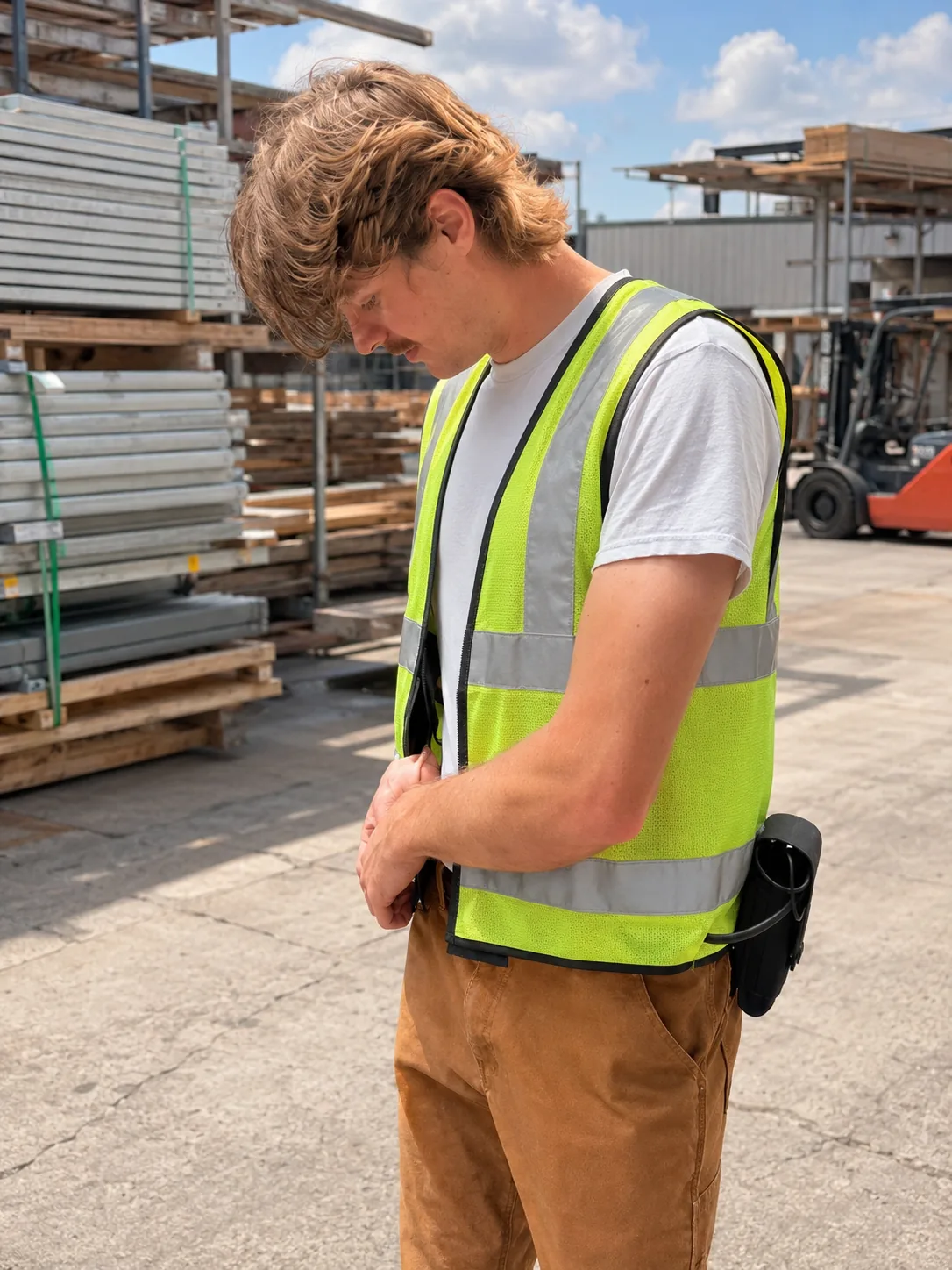
Yes. Clema is a solid-state active cooling vest built as a sub-3-lb suspender system, worn under a fall-arrest harness and hi-vis. It adds no bulk at the D-ring, no rigid plates across the back, and no water bladder that shifts weight when the worker leans into the slope.
How long does a cooling vest last on a roofing shift?+
Clema runs 8 to 12 hours on one battery swap. Ice and phase-change vests typically give 2 to 3 hours before they need a freezer, which on a roof means a ladder trip down, a drive to a freezer that may not exist on site, and a crew standing around while it refreezes.
Do cooling vests work in direct sun on a roof?+
It depends on the type. Evaporative vests need dry air and airflow, and stall in humidity. Ice and PCM vests are a fixed budget of cold that drains faster the hotter it gets, so peak roof conditions are exactly when they quit. A solid-state active cooling vest pulls heat with a battery-driven thermal loop, so its output does not depend on ambient humidity or on how much cold is left in a pack.
Does heat affect fall risk on a roof?+
Heat strain degrades reaction time, coordination, and decision-making before a worker recognizes it, which matters more at height than at grade. In Washington State construction, traumatic injury odds rose about 0.5% per 1°C of maximum daily humidex across 63,720 claims (Calkins et al., Scand J Work Environ Health, 2019). That is the practical argument for treating heat as a fall-protection input on roofing work rather than a comfort issue.
What is the best cooling vest for roofers?+
For roofing specifically, the deciding factors are runtime, harness compatibility, and independence from ice or water logistics. A solid-state active cooling vest is the only category that clears all three: full-shift runtime on one battery swap, sub-3-lb suspender form under a harness, and no freezer or refill station required on site.